
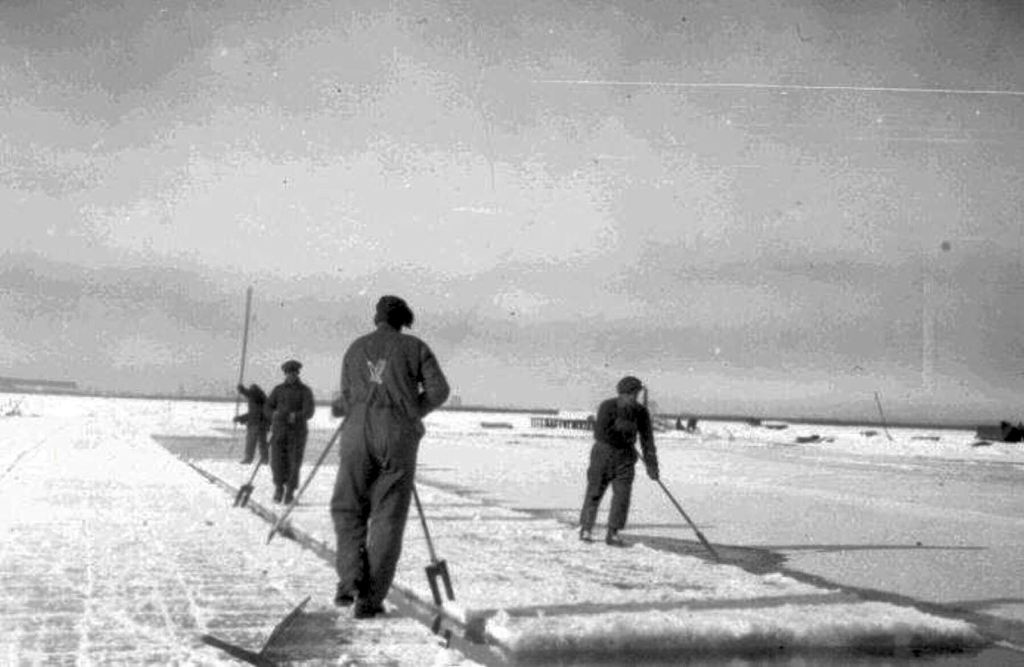
When I was a kid, we lived in a second-floor apartment in Sherbrooke. We had cold running water and we heated water on the woodstove. Our refrigerator was called an ice box, because it was a box into which we placed a block of ice ̶ ice which someone had cut from a lake and hauled to our front door by horse and wagon. George mentions a slop pail (not mentioned by name), and I became familiar with slop pails when we lived for a year on a Saskatchewan farm. All waste water and biodegradable garbage went into a slop pail. The pail was dumped on the garden as fertilizer.
“Mom brought the kettle with hot water and I used the dipper
from the pail to put cold water in. I saw a new bar of Lifebuoy
soap. I liked using that soap because my hands smelled so nice. I
poured the water out and it ran into the pail under the sink.
. . .
Mom put my porridge down. I heaped the porridge in the
middle and made my island. The brown sugar was the trees on it
and the Klim was the water. I could eat at the edges until the land
was all gone and then finish the milk.
. . .
[To make toast] was one of my favourite jobs. The toaster had two parts.
Each part was made [into a] square of stiff wire a little bigger than a
piece of bread. Each square had pieces of stiff wire going from
the front to the back. One piece of wire was longer and bent into
a handle and went back onto the frame. The two parts joined
together at the back with little rings. To use it you opened it up,
put a piece of bread on it and closed it, grabbed the handles and
held it over the coals. The toast looked pretty; it had lines where
the wire touched it . . .”
DO YOU REMEMBER . . .
a) products such as Lifebouy soap and Klim?
b) household appliances for which we have no use any more?
 E.J. Lavoie's Blog 3