
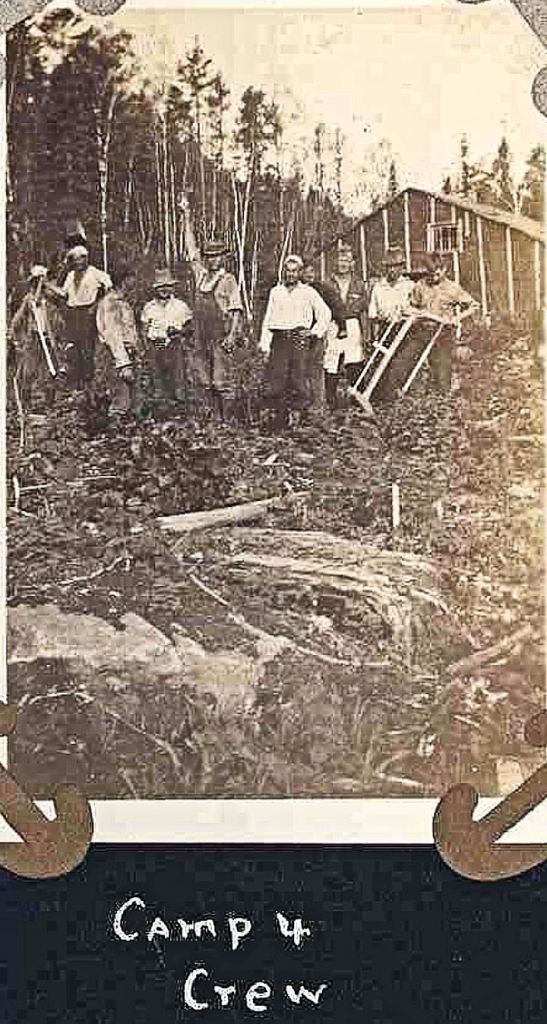
Credit George Johnson-David Black, Ontario History.
In my casual reading today, what should pop up but the names of Tom Johnson and Tony Oklend. Johnson and Oklend, discoverers of the Little Long Lac gold mine in what is now called Greenstone.
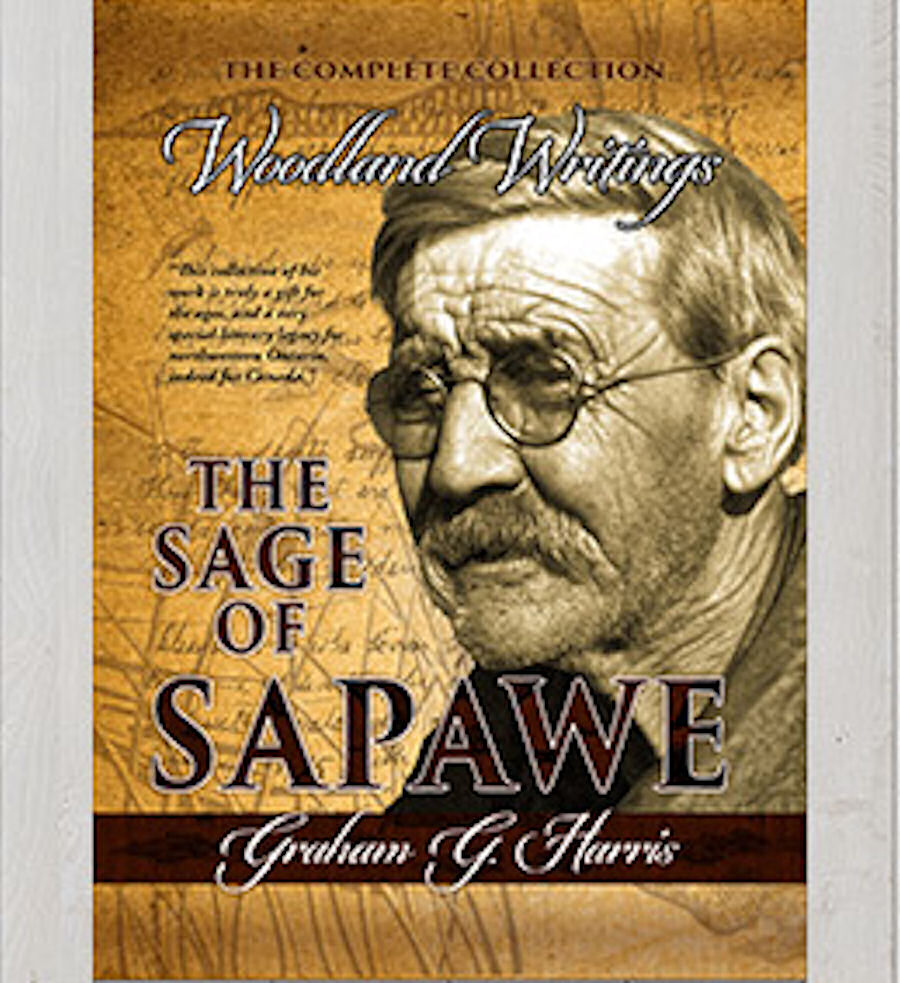
A week ago, I picked up a volume at a book fair: The Sage of Sapawe: Woodland Writings. It was a fat volume, 463 pages, hard cover, published by the Museum of Atikokan. It had a hefty price tag, too: $49.95 I have a weakness for local histories, whatever the price. The author was Graham G. Harris.
I asked the gentleman at the desk if he was the author. No such luck. Graham Harris, he said, died in 1958. Rats.
The Sage of Sapawe is a collection of the writings by Graham Harris from 1926 to 1958. Today, Sapawe is a wide space in the road between Thunder Bay and Atikokan. A glance tells me that the chapters range from historical notes, daily journals, and nature studies to poetry. My habit in reading histories is to spend a few minutes a day, and to savour every minute. I have many weeks, perhaps I have months, to extract pleasure. Doubtless I shall be repaid $499.50 and more.
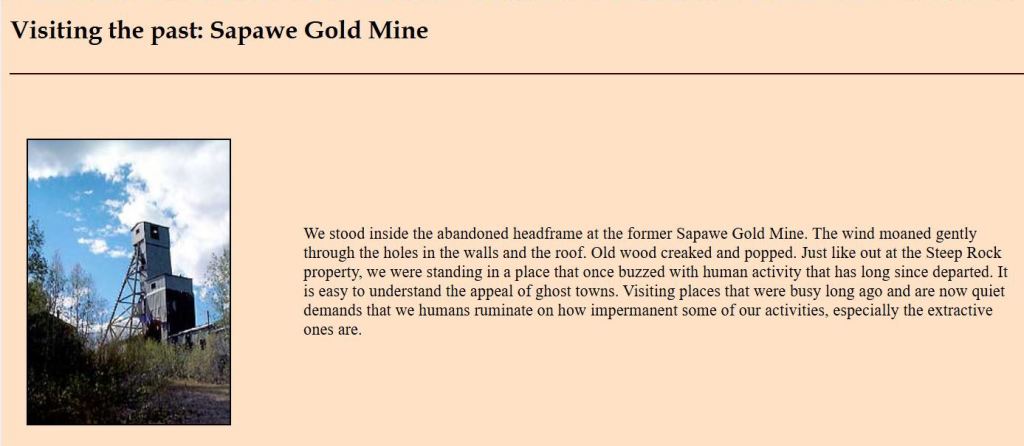
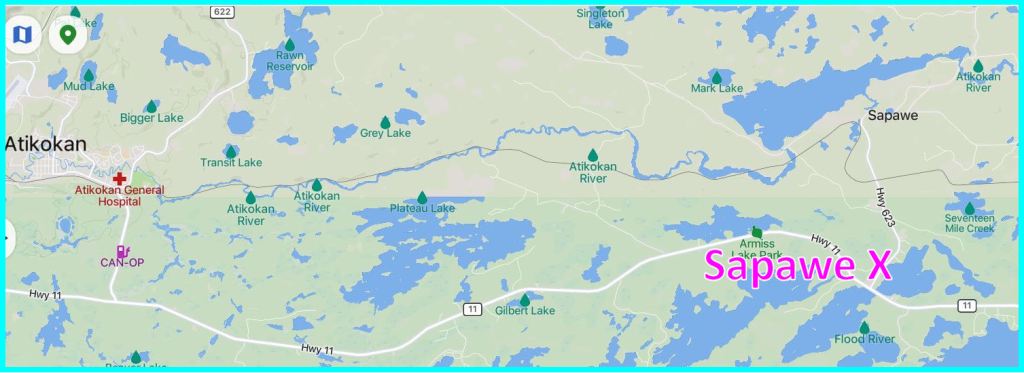
The first chapter dates to 1947: “A BRIEF RECORD OF THE SETTLEMENT AND ITS SURROUNDINGS . . . ” One extract reads “The birth of Sapawe as a village rather than a lake occurred in 1932; the [railway] section and vicinity before then being known as Iron Spur in reference to the Mine Track Junction [on the CNR]. The old name of the lake was spelled Sabawe, which means drowning, and by native report was bestowed as a result of a tragedy in which two Indian girls lost their lives through the swamping of their canoe in one of the summer squalls which still sometimes lash the shallow waters to sudden fury.
“In adopting the name for the village, however, a slight change was made because it seems neither appropriate nor charitable to associate a new-born community with drowning (one of the godfathers also pointed out that Sabawe left an impression of the speaker being afflicted with a cold in the head). Therefore, Sapawe was agreed upon as the official name of the station and post office, which were established that year, and Sapawe (not Sapawe Lake) is the correct postal address . . .”
This chapter reaches back to the likelihood of Radisson and Groseilliers travelling the region, and delves into the history of local mining ventures and logging operations.
Memorable mentions include Peter McKellar and J.A. Mathieu and Tom Johnson and Tony Oklend: “Temporary guests of the Settlement [Sapawe village] have included the co-discoverers of ‘Little Long Lac Mine’, Tony Oklen[d] and Tom Johnson, besides William [correct name is Joseph, not William] Errington, the promoter of the venture. Both Errington and Johnson later optioned and tested mineral showings the field, but Tony, whose previous career as an illiterate railroad labourer had not fitted him to control wealth, soon left Sapawe to start an orgy of spending that probably hastened his death five years later . . .”
“But this territory has for ages harboured other than human inhabitants and these have a right to some place in history.
“Fifty years ago, moose and woodland caribou are said to have been the most plentiful of the deer tribes represented in the area. Then, the white-tailed deer began to migrate here from the south and east, bringing with them more timber wolves to swell the ranks of those already in the country. Since then, there has been a slow but noticeable decline in the number of moose and the fine caribou of the woods appears to have vanished entirely ̶ the last specimen seen here being reported over twenty years ago.”
This reference to caribou intrigues me: I may have seen one of the last caribou in the area. On a solitary road hunt outside Thunder Bay in the fall of 1969, I witnessed a caribou crossing in front of me during a snowstorm.
Also, I taught two years in Atikokan, 1959 to 1960. “Atikokan” is an Aboriginal word meaning “caribou bones” or “caribou crossing”.
Now, you can’t tell me that the past few minutes of reading have not given you pleasure. But, can you put a dollar value on them?
 E.J. Lavoie's Blog 3
I believe my Uncle Vince lived there at one point. For some reason which I never understood as a child my parents sort of made fun of this place.
LikeLike