
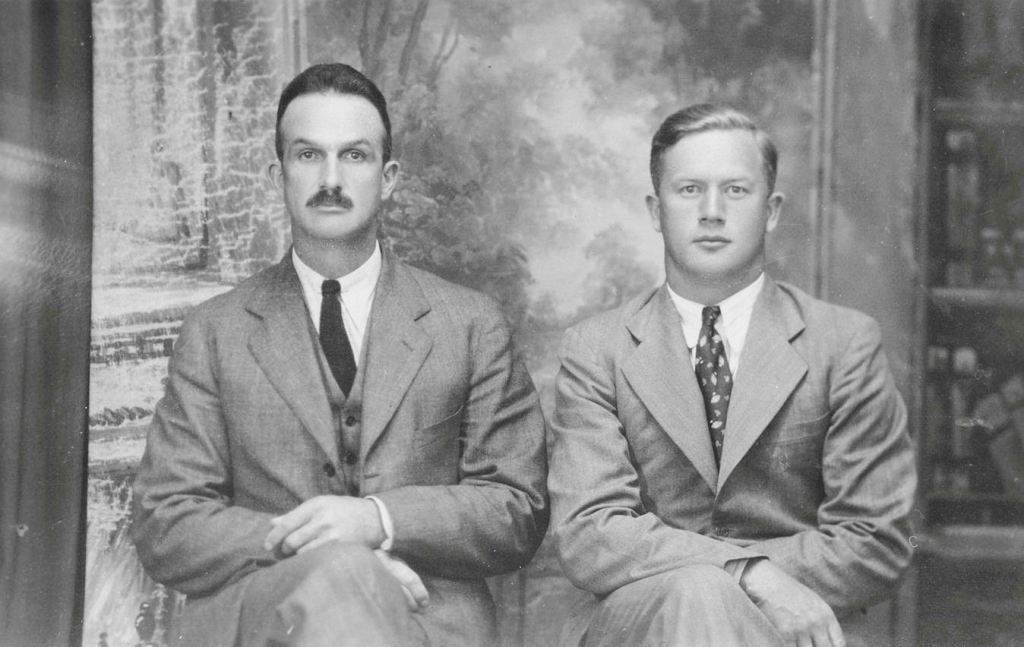
Tom (left) and Bill Johnson, 1936. Credit Johnson Family Album.
This article was published on Saturday, May 11, 2024, in Thunder Bay Chronicle-Journal.
In the summer of 1931, “Hardrock” Bill Smith staked claims on Kenogamisis Lake and sparked a short-lived gold rush. A year later, Tom Johnson, prospector, drawn to that lake, aka Little Long Lac, staked claims there. At that location would rise the first mining headframe of the district.
Born in the Ottawa valley in 1888, Thomas Alexander Johnson staked his first claim in the Timmins area in 1911. During the Great War, he suffered chlorine gassing, but he recovered and moved to Hearst, where his family had relocated. He explored for gold all over Northern Ontario and into Manitoba. He never married. In October 1931, he left his properties just east of Lake Nipigon, and together with partner Robert Wells staked claims on Magnet Lake, just west of Little Long Lac. In 1934 they became Bankfield Gold Mines Ltd.
In the summer of ’32, he hooked up with Tony Oklend, trapper and sometime prospector and railway section worker, and together they found a mine on the south shore of Barton Bay, Kenogamisis Lake. Little Long Lac Gold Mines (incorporated 1933) poured its first brick in 1934. The mine was developed by Sudbury Diamond Drilling Co., spearheaded by president S.J. Fitzgerald and vice-president Joseph Errington. A townsite called Geraldton was developed on the north shore of Barton Bay, with the names Fitzgerald and Errington incorporated into the new community’s name.
Contemporaries described Tom Johnson as a hardworking prospector, able to pound hand-steel (to drill holes for dynamite sticks) 12 hours a day. He dug trenches by hand in overburden to expose veins. He paddled and packed. He staked and assessed and sold numerous claims, but his first success as a mine-finder came in the fall of 1931 with the Bankfield mine. Immediately west from Magnet Lake he staked claims which became Tombill mine (inc. 1935), named for Tom and his brother Bill. His partner, Robert Wells, staked immediately east; his claims became Magnet mine (inc. 1936)). Tied on to the west of Tombill claims, others staked what became Jellicoe mine (inc. 1936).

Tom Johnson poses with first brick at Tombill mine, 1938. Credit Greenstone History files.
Tom Johnson was a restless soul. In the summer and fall of 1932, while waiting for geologists and mining engineers and investors to do their thing, Johnson poked around in the bush. At the extreme west end of Barton Bay, he found what would become Elmos mine (inc. 1936). The following summer he found Dik Dik mine (inc. 1933), east and north of Jellicoe. A friendly guy, but shy and solitary by nature, Johnson never attended brick pourings, with one exception, the first brick at Tombill mine.
Over its lifespan, 1934 to 1952, Little Long Lac mine yielded 605,449 ounces of gold. Johnson and his onetime partner Oklend were rumoured to be millionaires. When Johnson retired in Hearst, he built a dairy farm, leaving it to Bill to manage. He died in 1944 at age 56. His will disclosed assets of $127,000, which is about 2 million in today’s dollars. He bequeathed generously to brothers, sisters, and special friends, and left half the residue to the Canadian Red Cross to be spent in Northern Ontario.
In 1934, “Hardrock” Bill Smith’s claims had become Hard Rock Gold Mines in the Little Long Lac Gold Camp. Back in 1931, Smith had advised two friends to tie into his Kenogamisis claims, and in 1938, the MacLeod-Cockshutt mine (inc. 1933) became operational as the largest regional producer. Today these properties are known as Greenstone Gold Mines, scheduled to go into production by June 2024.
In 1937, Geraldton was incorporated as a town. For a short time, one of its suburbs was called Johnsonville, after Tom and Bill. Today, the town has a one-block-long Tombill Avenue, but it is a challenge to find it. Otherwise, no geographical location in the Municipality of Greenstone preserves the name Tom Johnson, Father of Geraldton and of the Little Long Lac Gold Camp.
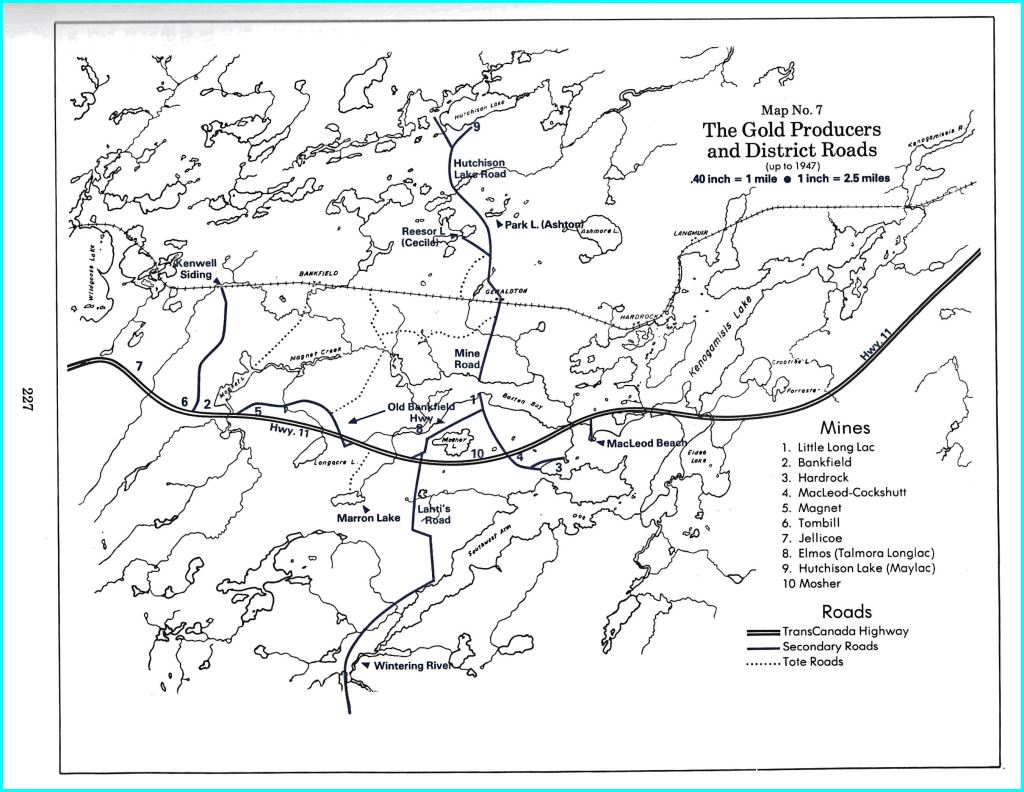
Map from And the Geraldton Way.
 E.J. Lavoie's Blog 3