

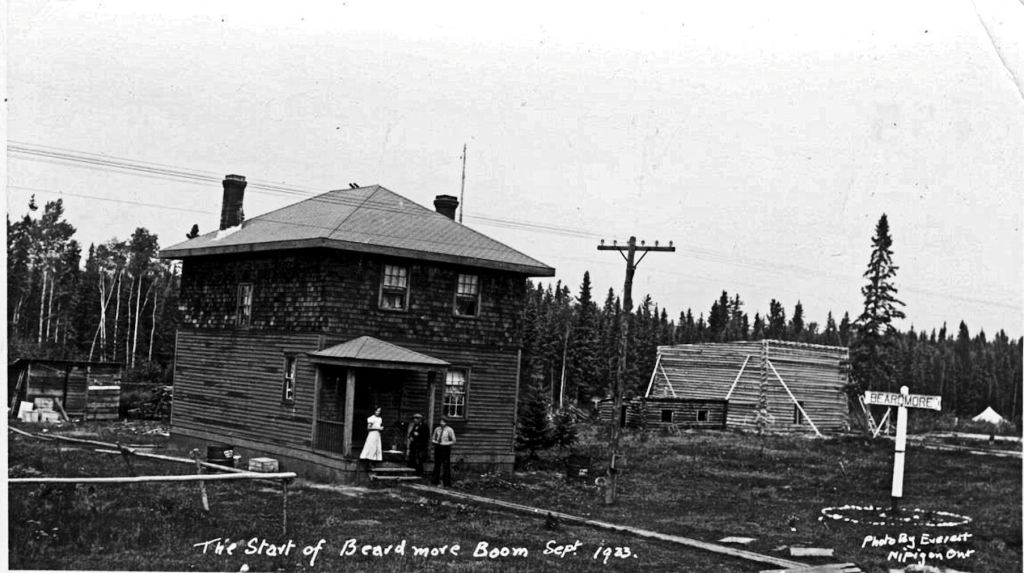
In 1925 Beardmore was just another lonely flag stop on the CNR line at Mileage 20.5 (measured from Jellicoe). Beardmore consisted of a section house (CNR property) and a section gang (a railway maintenance crew). Then someone struck gold at Mileage 19.5.
Beardmore Gold Mines Ltd. worked the prospect for years with little success. In 1932 the newly formed Northern Empire Mines Ltd. took over the property, and things began to happen.
By 1934 the Northern Empire had all the components of a working mine. A townsite sprang up for the workers and their families. The first brick was poured in April, and the Northern Empire became the first producer in the gold field that stretched from Lake Nipigon to Long Lake.

now-decommissioned railway.
People called the mine townsite Empire. The federal government granted Empire a post office. Residents made plans for a school. Newspapers referred to the new town of Empire, “formerly known as Beardmore”.
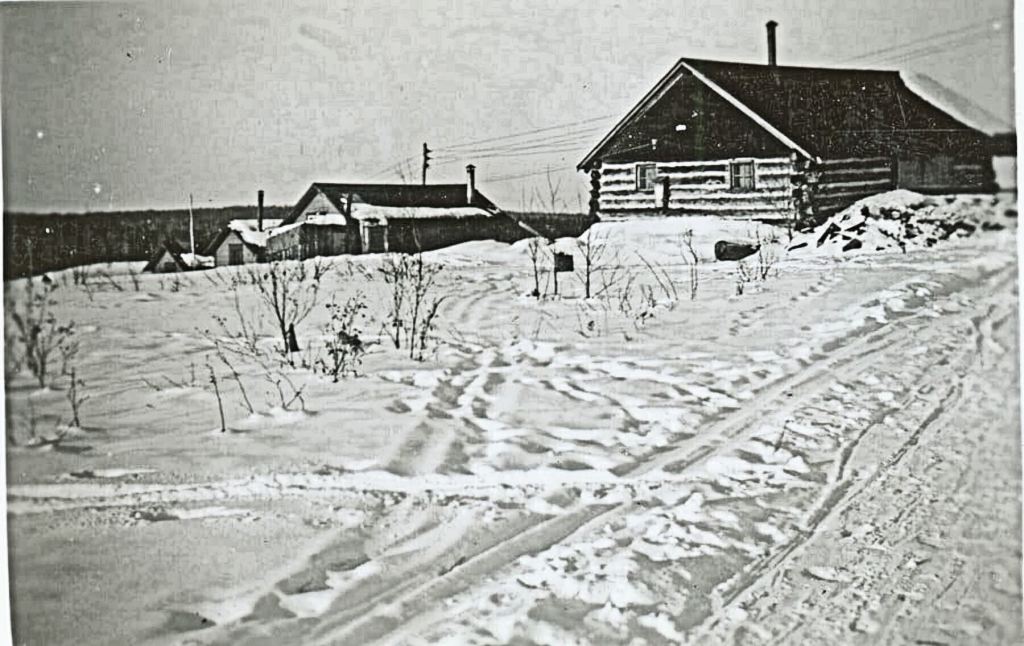
Meanwhile, Beardmore had grown to one small hotel, a store, and few cabins. It still had no railway station and no post office. But Beardmore had something else. Location. It was located beyond the control of any mining company.
Hundreds of men toiled away in the bush around Beardmore, exploring likely prospects. The bush buzzed with news of shaft-sinkings, actual ones and imaginary ones. Anyone who didn’t work for the Northern Empire looked to Beardmore as a supply depot.
Beardmore’s popularity rose for another reason. A man toiling from dawn to dusk tends to develop a thirst. The government required that all mining townsites, including Empire, be “dry”. Beardmore was far from dry.
Today, Empire is just another ghost town of the North. The ghost town is now an empty space, invaded by the bush, with not a single building left standing.
Refer to the post by Ken Johnson about Empire’s post office history.

 E.J. Lavoie's Blog 3
In the 1980’s, when I was a writer broadcaster with CBQ, I visited the sites of 2 gold mines near Beardmore. One was the location of the old Teresa mine. The price of gold at that time was high and technology had been developed to mill the piles of rock left when the mines were active. I don’t know the outcome of those ventures. I also interviewed Ed Rentz (sp?) folk carver and fiddler, in his barber shop and remember the deer skin curtains with bead trim in the hotel dining room. I believe this same hotel was where Norval Morriseau connected with the art world.
LikeLike
Hi, Elaine, the Theresa Mine was located just southeast of Longlac, so you are probably thinking of another mine. Any chance you can turn up a transcript of that interview with Ed Rentz? The old Leitch mine had piles of waste rock, which have since been utilized in building projects.
LikeLiked by 1 person
Thanks for the clarification on location. Memory is faulty. Was there a site on the road to Poplar Point Park at Beardmore? I did interview you in Geraldton and went to Nakina—Katimavik was there doing a project in Aroland. They ate in the beanery at the old Nakina railway station. The interview with Ed Rentz didn’t survive and it’s a real loss.
LikeLike
Yes, Leitch mine is on the road to Poplar Point.
LikeLike