
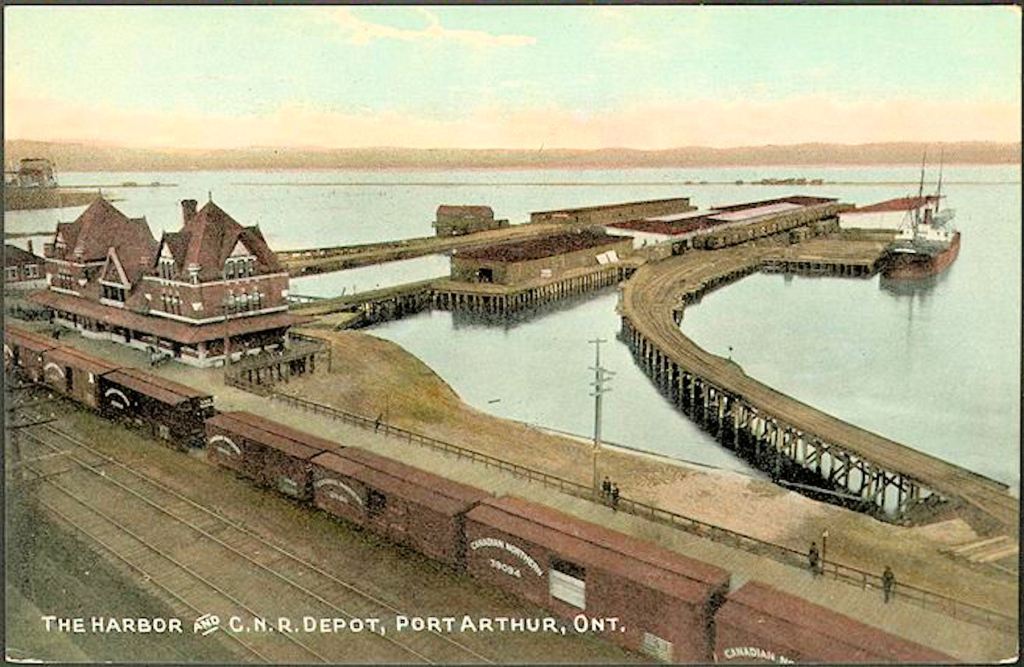
In July 1905, Donald Mann visited Port Arthur (now part of Thunder Bay). He and his wife arrived in their private railway car on the Canadian Northern Railway. There was talk about the Grand Trunk Pacific buying out the CNR.
Donald Mann along with the co-founder of the CNR, William Mackenzie, were still trying to figure out how to tie together their Southern Ontario line with their Western Canada line which ended in Port Arthur. The palatial station they built in 1906 on Water Street still stands, but the docks and railway yard have been consigned to history.
The Canadian Northern Railway route to Port Arthur meant travelling from Winnipeg, crossing into Minnesota, crossing into Canada again at Rainy River, and travelling westward to the twin Lakehead cities.
The Grand Trunk Pacific was about to embark on the construction of a short line, Fort William to the vicinity of Sioux Lookout. It would link their northern railway line (now the northern line of Canadian National Railways), the second transcontinental line then under construction. The Canadian Pacific Railway line, the first transcontinental, had been operating since 1885.
The Grand Trunk Pacific, Lake Superior Branch, had already been guaranteed oodles of cash and acreage to build their line starting in Fort William. Mackenzie and Mann were struggling to raise capital for their proposed short line from the East to link up with the West. Mackenzie began his illustrious career as a railway conductor; Mann began his as a railway contractor. Now, thanks to their deal-making, they owned the third largest railway system in Canada, after the CPR and the Grand Trunk (note the name ̶ the Grand Trunk Pacific was a subsidiary). And they wanted to create and own a third transcontinental railway.
The 14th July edition of Fort William’s Daily Times-Journal gives an insight into the personality of Donald Mann:
“D.D. Mann, of the firm Mackenzie & Mann, the famous contractors, arrived in Port Arthur last night on his special car the Athabaska, which was attached to the C.N.R. from the west. Mr. Mann was accompanied as far as Port Arthur by his wife and son, who are now registered at the Marriagi, as business of a very exigent nature compelled Mr. Mann to leave shortly after his arrival for Toronto.
“The Times-Journal representative had the pleasure of a few minutes chat with the great contractor, but found him very much disinclined to take about business matters, although he was in his usual good spirits. Mr. Mann said: ‘I am not going to discuss business with you tonight, as there are times in our lives when we like to cast the cares of business life to the winds. Newspaper men are a very inquisitive lot. I would never be surprised if one of them solicited access to my bank book (not that I have any.)’ and then a twinkle came from his eye that spoke volumes. The reporter was anxious to talk business and asked Mr. Mann if there was any truth of the Grand Trunk Pacific absorbing the C.N.R. and Mr. Mann’s answer was a negative one.
“‘When do you expect to be in Port Arthur again?’ Mr. Mann was asked, and his reply was that he expected to be up here very soon, and in view of Mrs. Mann’s presence in the town it [was] thought Mr. Mann will return in the immediate future.”
The phrase “Mr. Mann to leave shortly . . . for Toronto” would describe his intention to take the CPR train, which would take mere hours, because the steamer route through the Great Lakes would take days.
In 1914, Mackenzie and Mann’s short line eventually linked Capreol with Port Arthur. It was named Canadian Northern Ontario Railway. The portion that ran between Longlac and Port Arthur was once up a time named the Kinghorn Subdivision.
Today this short line is a footnote in history. The book has yet to be written to detail Mackenzie and Mann’s grand visions and magnificent exploits in a Pierre Bertonesque fashion . There are many histories about the Canadian Northern with loads of boring stuff. We need a popular history with fascinating details and juicy stuff. If you are willing to write it, I will read it.
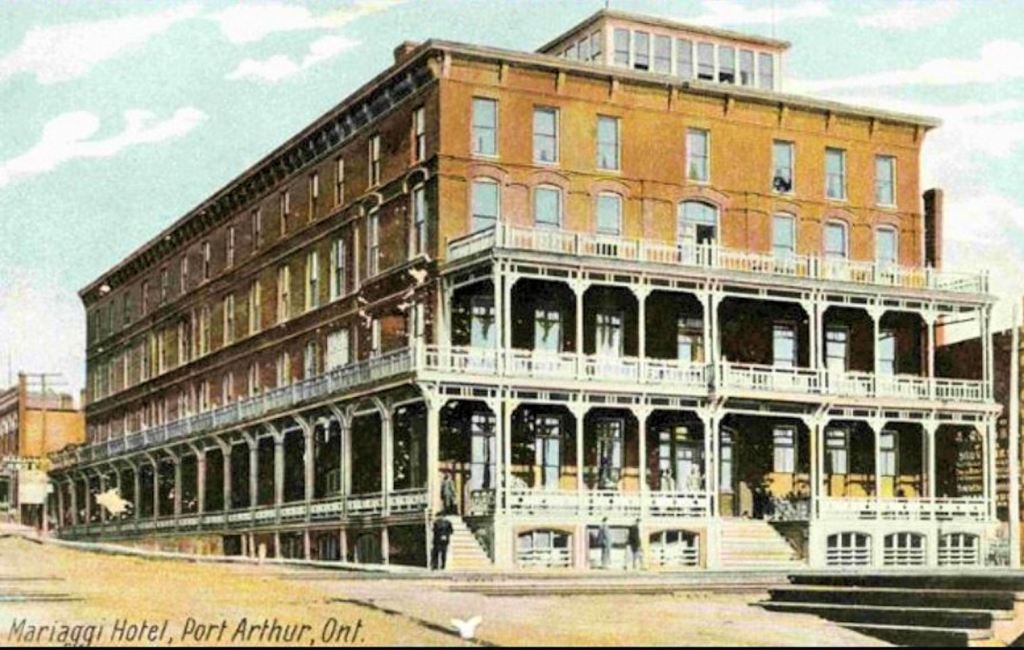
the CNR station on Water Street.
(Continued in Part 2)
 E.J. Lavoie's Blog 3